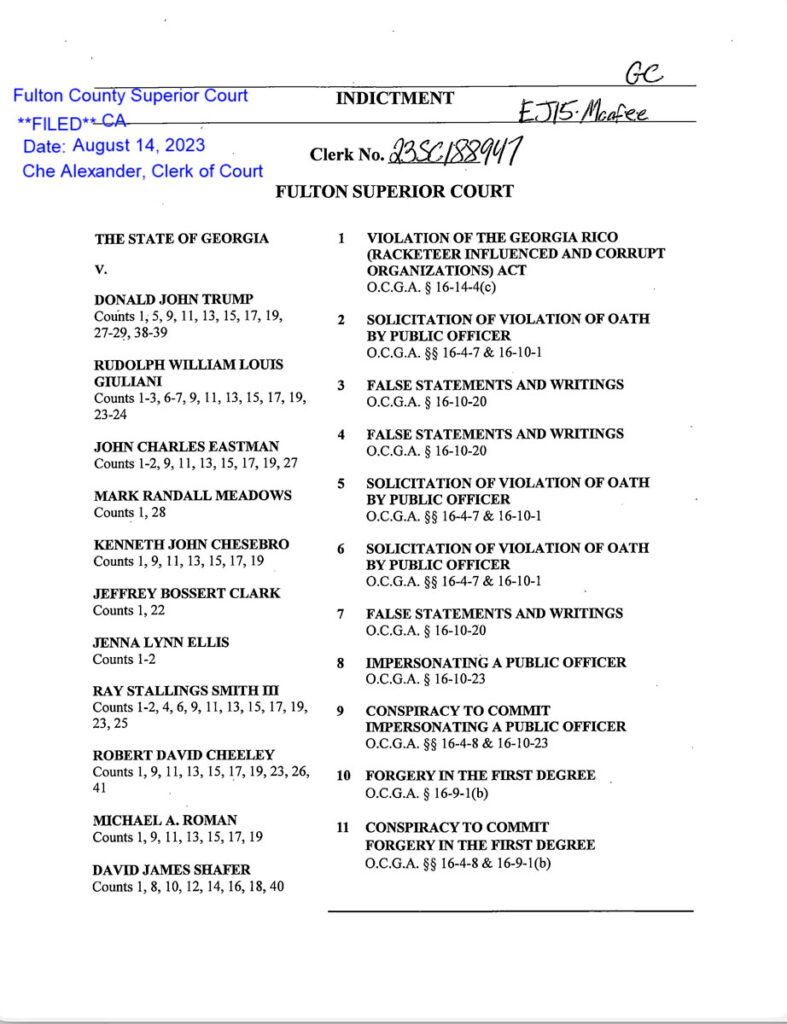
You can download the entire inscrutable document here.
Or you can get all the essential info below, in a more digestible form...
State of Georgia v. Donald John Trump et al.
Court: Fulton County Superior Court, Georgia
Filed: August 14, 2023
Prosecutor: Fulton County District Attorney Fani T. Willis
Defendants: Donald John Trump and 18 co-defendants
Primary Charge in Count 1: Violation of the Georgia Racketeer Influenced and Corrupt Organizations Act
Summary
In August 2023, a grand jury in Fulton County, Georgia, returned a sweeping 41-count indictment charging former President Donald John Trump and 18 others with participating in a criminal enterprise designed to overturn the results of the 2020 presidential election in Georgia.
The central accusation is that the defendants formed an organized effort to unlawfully change the outcome of Georgia’s presidential vote after Trump lost the state. Prosecutors allege that this effort was not a series of isolated acts, but a coordinated plan involving false statements, pressure on public officials, the creation of false electoral documents, harassment of election workers, and unlawful access to voting systems.
Count 1 charges all 19 defendants with violating Georgia’s Racketeer Influenced and Corrupt Organizations Act, commonly known as the RICO statute.
Background
Donald John Trump was the Republican candidate for President of the United States in the November 3, 2020 election. He lost the election nationwide and lost the state of Georgia.
According to the indictment, Trump and the other defendants refused to accept that result. Prosecutors allege that beginning shortly after Election Day and continuing into September 2022, the group knowingly and willfully joined a conspiracy to unlawfully change the outcome of Georgia’s presidential election in Trump’s favor.
The indictment states that the alleged conspiracy operated in Fulton County, elsewhere in Georgia, and in several other states including Arizona, Michigan, Nevada, New Mexico, Pennsylvania, Wisconsin, and in the District of Columbia.
The Alleged Enterprise
Count 1 alleges that the defendants and other unnamed co-conspirators formed what Georgia law calls an “enterprise” — an organized group of individuals associated together for a common purpose.
That purpose, according to prosecutors, was to overturn Georgia’s lawful presidential election results.
The indictment names 19 defendants, including Donald John Trump, attorneys Rudolph William Louis Giuliani and John Charles Eastman, former White House Chief of Staff Mark Randall Meadows, and several other lawyers, political operatives, and Georgia Republican Party officials.
Prosecutors allege that members of this enterprise engaged in related criminal acts including making false statements, impersonating public officers, forgery, filing false documents, influencing witnesses, computer-related crimes, conspiracy to defraud the state, and perjury.
The indictment describes the enterprise as an ongoing organization whose members functioned as a continuing unit and coordinated activities across multiple states.
The Alleged Scheme
The indictment outlines several methods the alleged enterprise used in attempting to overturn the election results:
- Making false statements to Georgia legislators and urging them to reject certified electoral votes.
- Pressuring high-ranking state officials, including Georgia’s Governor and Secretary of State, to alter or overturn certified results.
- Creating and transmitting false Electoral College certificates claiming Trump had won Georgia and other states.
- Harassing and intimidating Fulton County election worker Ruby Freeman with false accusations of election fraud.
- Pressuring officials at the United States Department of Justice to declare the election corrupt.
- Urging the Vice President of the United States to reject lawful electoral votes during the January 6, 2021 joint session of Congress.
- Accessing voting equipment and election data without authorization.
- Filing false documents and making false statements to investigators in what prosecutors describe as efforts to further and conceal the conspiracy.
Count 1: RICO Charge
Count 1 alleges that from November 4, 2020, through September 15, 2022, the defendants conspired to conduct and participate in the enterprise through a pattern of racketeering activity.
Under Georgia law, a RICO charge requires proof that the defendants were associated with an enterprise and that they engaged in a pattern of criminal acts in furtherance of that enterprise.
The indictment lists dozens of “overt acts” that prosecutors say were committed to advance the alleged scheme. These acts include speeches falsely declaring victory, phone calls to state legislative leaders, press conferences alleging election fraud, meetings at the White House with state officials, public statements and social media posts claiming fraud, coordination of alternate elector meetings, and communications organizing the transmission of electoral certificates.
Prosecutors contend that these acts demonstrate a coordinated effort rather than independent political advocacy.
Conclusion
This indictment does not determine guilt. It represents formal accusations returned by a grand jury after hearing evidence presented by prosecutors.
The defendants are presumed innocent unless and until proven guilty in a court of law.
Why This Case Matters
This case is one of the most significant state criminal prosecutions ever brought against a former President of the United States.
It tests how far state racketeering laws can reach into political conduct surrounding federal elections. It also raises profound questions about the limits of political advocacy, the rule of law, and accountability for efforts to challenge certified election results.
Whatever the eventual outcome, the case will likely shape how future election disputes are handled and how state criminal laws apply to national political campaigns.
Endnotes
Georgia Racketeer Influenced and Corrupt Organizations Act, O.C.G.A. § 16-14-4
Violation of Oath by Public Officer, O.C.G.A. § 16-10-1
False Statements and Writings, O.C.G.A. § 16-10-20
This article is provided for educational purposes only. It summarizes publicly filed court documents and does not constitute legal advice.